A blog for medical students, faculty and librarians about their use of evidence based medicine, clinical literature, Web 2.0, sources and search strategies
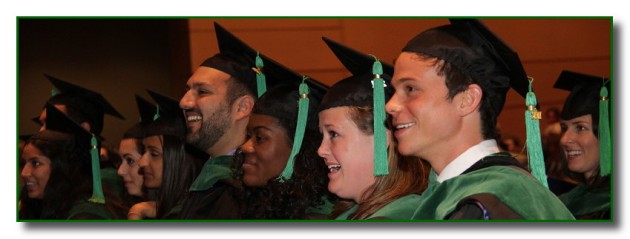
Congratulations to every graduate in the University of Connecticut Health Center Class of 2011
You did it!
Ceremonies were held in Hartford on Sunday, May 15 2011
Image source: Courtesy of John Atashian Photography – Copyright 2011 – All rights reserved
Since the first class was graduated in 1971, University of Connecticut has conferred a total of 2,975 MD and 1,413 DMD degrees. Today’s ceremonies granted degrees to 81 physicians and 42 dentists.
As accident re-enactments go, this one is pretty Riveting
Links courtesy of NJ.com and Exosphere3D – All rights reserved – Copyright 2011
.
The focus and calm of U.S. Airways Captain Chesley Sullenberger can be appreciated by listening to the audio portion of this re-enactment, as he made critical analyses – over a period of only a few minutes – on how (and where) to land a disabled aircraft sinking earthward over a densely populated area. His decisions saved 100% of the lives on board that day.
Hang out with a bunch of epidemiologists long enough and eventually the conversation while turn to Causality. They will tell you that there are some big differences in semantics between linking causation, etiology and “proof” that X exposure caused Z disease or health condition. When I looked up the terms “causation” and “causality” (on Google) there were major sidetracks, such asWBA (Why-Because-Analysis) as in, Why did the airplane crash? Why did the reactor experience a meltdown?
Why? From the viewpoint of a physician, an engineer or an epidemiologist… because of X-Y-Z.
X-Y-Z could be bird strikes, human error, engine failure, weather conditions, crazed people bearing guns, lack of fuel or a thousand other accidents waiting to happen. Often the causes can be identified. Sometimes one can only attribute unanticipated events to gauzy, fuzzy concepts such as “it was a one in a million chance” or “this was God’s will”, “causes unknown” or just plain Karma. The harder (non-fuzzy) data can be applied towards improvements in systems design, development of new vaccines, engineering safety… all targeted towards avoidance of future accidents (or disease outbreaks).
___________________________________
Epidemiologists save lives. Sometimes this association accumulates slowly… as in proving associations between Exposure X and development of Disease Y decades later. In other cases, evidence mounts up as an emergency, such as the identification of a novel virus identified as SARS in 2002. But linking health effects of exposures over a human life-span is so much more elusive than showing evidence that birds got sucked into a jet engine at 2,500 feet (as above).
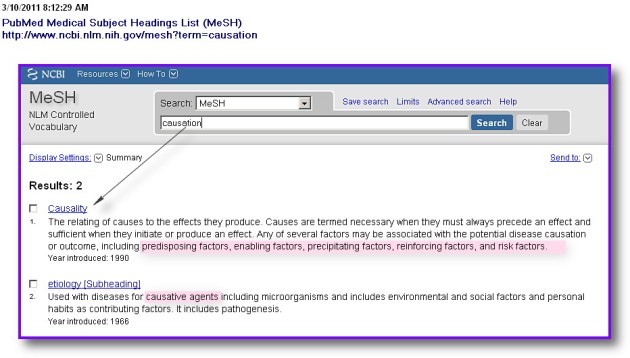
Turning to the PubMed database, a screenshot below fromMedical Subject Headings List (MeSH) reveals how the term “causation” is mapped in the online thesaurus of medical indexing terms:
One way to search a large database such as PubMed is to simply type in some words – for an example, Liver Cancer AND Epidemiology. This pulls up over 18,000 retrievals… too many (!), but by then selecting and applying standard Limit Fields such as Language, Journal Subset, Age Group, Gender and others, the retrievals can be filtered down to a more-manageable number.
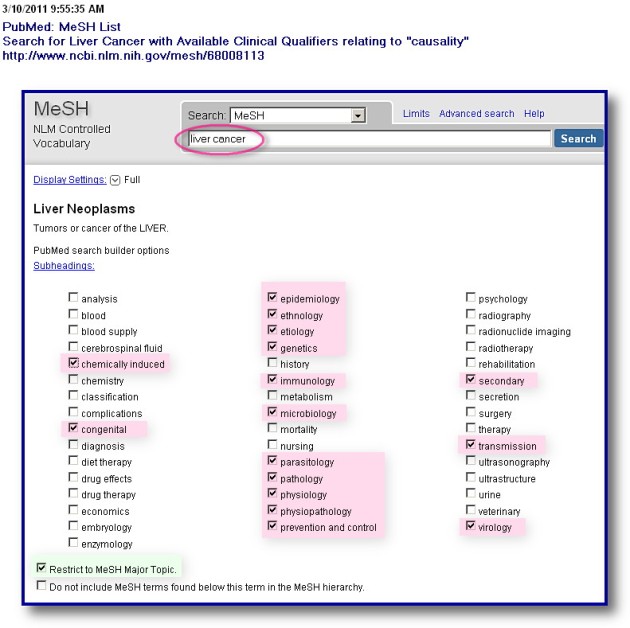
A more precise way to search a large database like PubMed is to use the Medical Subject Headings list. In the example below, the term Liver Cancer was typed into the MeSH search page, which maps automatically to the preferred MeSH term — Liver Neoplasms. While this search still retrieves thousands of citation, they can be limited by selecting and applying any MeSH Subheading (or clinical qualifiers) that are appropriate to the search. These subheadings include clinical concepts such as Virology, Immunology, Genetics, Epidemiology, Transmission and 80 others. Following is a screenshot of that type of search:
Remember that a librarian’s idea of “causality” could be defined, in part, by the number or types of clinical subqualifiers selected (immunology, virology, epidemiology and those types of “background” concepts) to be combined with the formal MeSH term.
There are many ways to search. It helps a novice medical searcher sometimes to tell them just that: There is no one right way to search. Sounds enigmatic and it is.
Here is an example which I found recently in the medical literature, a 2010 article which discusses application of Bradford Hill criteria (listed here):
Those searching for practical answers about causality, transmissible agents, disease etiology, global prevalence or current treatments might want to search GIDEON (Global Infectious Disease Epidemiology Online Network), an interesting “niche” information source targeting the research requirements of epidemiologists, clinical & translational researchers, MPH students, toxicologists or anyone interested in tracking or diagnosing infectious diseases on a country- or world-wide scale (subscription required). Updated weekly, the database is produced by Gideon Informatics and hosted on the EBSCO platform.
A search for causality or epidemiology done in the resources indexed by GIDEON is quite unlike a search done in PubMed about the etiology of Liver Cancer. The producers collect, review and index factual data collected from around the globe; their data encompasses a wide and diverse group of human cultures, agricultural, societal, economic or environmental practices.
Below is a screenshot of one example of the type of data that can be searched on GIDEON: bacterium (causative agent), typhoid (identifiable infectious agent) and United States (location, recorded incidence over time):
.Finally, a screenshot of What’s New at GIDEON (May 11 2011):
Image Source: GIDEON – All rights reserved – copyright 2011
If you are an American who reads news articles or listens daily to TV, then the budgetary skirmishes being played out between the two governing parties in Washington this month is enough to keep you up at night.
Do our elected government representatives deserve congratulations for haggling for days about and then (at the last minute) passing yet another temporary budget in order to keep the Federal government functioning on a daily basis?No.I say: Skip the drama and get back to governing the country in a cooperative, fair manner that represents the wishes of the people from your home state who voted for you. Sadly, long-term strategical thinking as well as respectful debate seem in short supply in our capital nowadays.
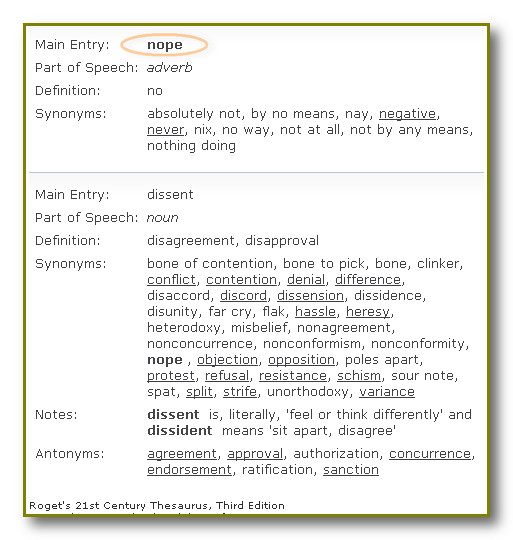
Am I a tea-partier? Nope. Is this blog about politics? Nope. What this blog is about is clinical education, health science research, instruction, trends in searching, public health, epidemiology, health care environments… and the infrastructure supporting these ideas and practices.
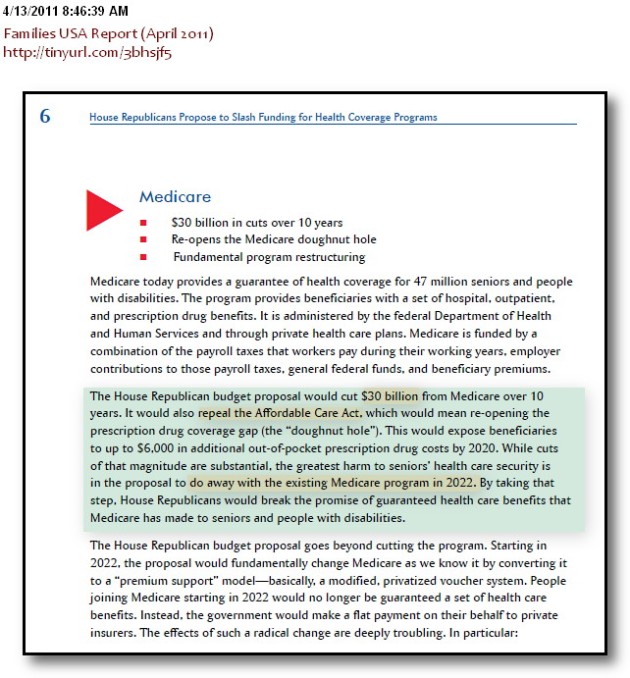
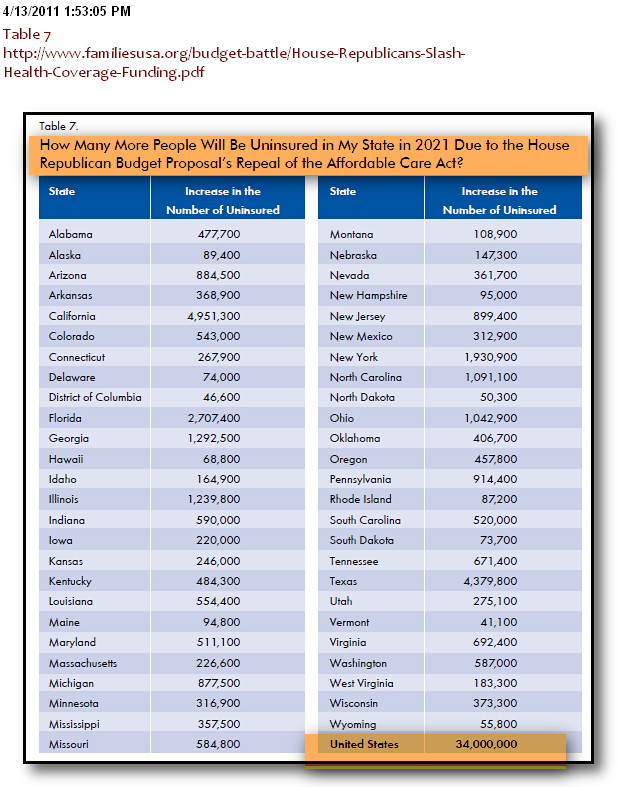
This month – from a public health viewpoint – it is troubling to read and hear about challenges to the health care safety net that the 2012 budget proposals being set forth by House Republicans have raised. If their version of health care reform is enacted, the health care delivery system for children, disabled individuals or senior citizens will be very different by year 2021.
Families USA, a nonprofit policy group, published a report last week that examines the Republicans’ health care reform proposals; it is available online at no cost by clicking here. It is highly critical of the proposals. Below are two screenshots from this report:
At this link, the proposed 2012 budget set forth by the current administration can be read online via the Congressional Budget Office (216-page PDF). Also see a link to the Health Care section for specific numbers and rebuttals to the Republican proposals.
Thanks to Matthew Sturdevant, insurance reporter for The Courant (Hartford, CT newspaper website) for the link to the Families USA report.
Spring has finally arrived. At this time of year – March Madness – it is so easy to get caught up in the hoopla and excitement surrounding men and womens’ College Basketball. In 2011, this is made easier by the fact that both the UConn women and the men are doing very well in tournament play… Go Huskies!
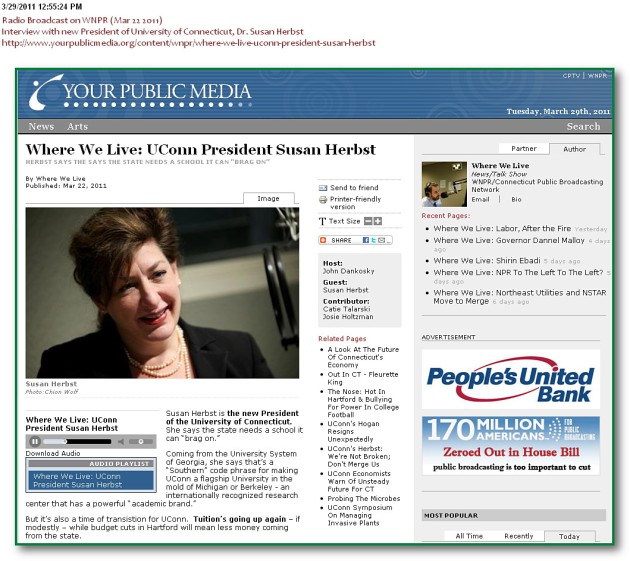
However, a lasting and more significant change in academic leadership is set to take place in July 2011, with the arrival of the next University of Connecticut president, Dr. Susan Herbst.
Life-changing events continue hard for the citizens of Japan, as the world watches them cope with multiple environmental disasters after surviving a 9.0 magnitude earthquake (a Big One) that hit near the northeast coast of the island near Honshu on Friday, Mar 11 2011. An eyewitness filmed this video clip which illustrates with utter clarity the frightening speed and power with which the ocean wave destroyed portions of Miyako City (footage from BBC website, dated Mar 17 2011). The latest death toll shows that 10,000 perished on that day, another 12,000 are still unaccounted for ten days later.
For the estimated 500,000 survivors, the basics of human requirements are being met, but supplies are scarce. Many are living in shelters. It will take months to clean up the rubble, and years to restore the damage to the infrastructure. As those who lost loved ones are required to re-define their “new normal”, psychological and counseling services will be in demand.
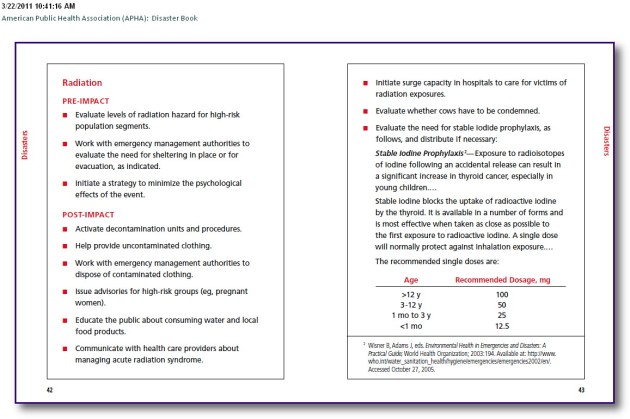
The challenges facing officials in the Japanese government in the aftermath of the quake and tsunami started out complex and have only grown more so over last ten days. A different public health emergency for these agencies is to contain radioactive materials from being released by quake- and tsunami-damaged nuclear reactors at the Fukushima Daiichi nuclear power station (built in 1979), an event which has been described as one of the most serious civil nuclear accidents in history. Protection of humans from exposure to radiation is of course the immediate concern; downstream, scientists will have a large amounts of data to collect as they examine health effects from three separate catastrophes.
Below is a map illustrating the 20km exclusion zone (12.4-mile radius) surrounding the Fukushima power facility (from BBC, published Mar 21 2011):
Following is a brief selection of sources for links to specific medical information and relief efforts taking place in Japan – mainly from websites outside of the country.*
Doctors Without Borders has had physicians and clinical staff working in the region since March 12. Link to their Japan page to read their daily news updates.
National Library of Medicine (NLM ) produces many information resources for epidemiologists, clinicians and public health officials to use to deal with environmental disasters. Since the monies to fund these agencies is from public tax-dollars, everything on the sites from NLM is on open access, available to anyone in the world to use. How cool is that!
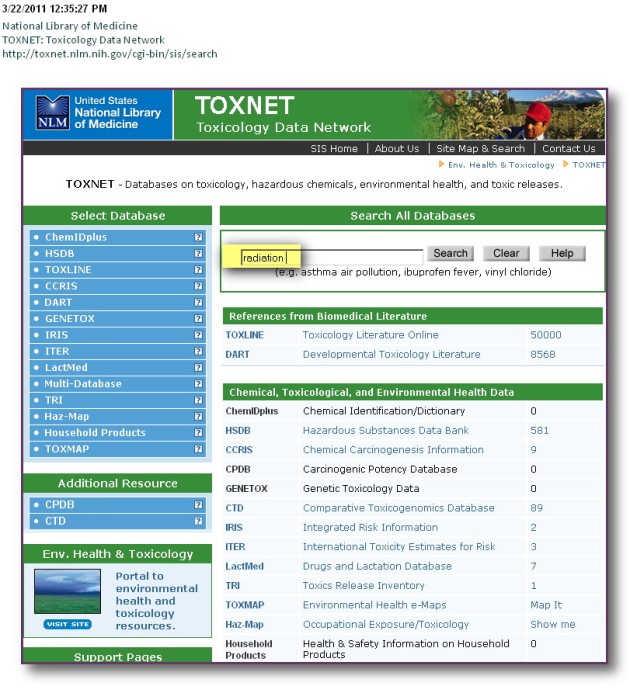
First, Toxicology Data Network (TOXNET), is a gateway site from which groups of individual database can be searched. Below is a sample search on the term “radiation“:
Image Source: NLM Toxnet – All rights reserved – copyright 2011
Image Source: ASPH – All rights reserved – copyright 2011
Environmental Health & Toxicology is a wide-ranging portal from NLM. After clicking on the “health professionals” link… I found access to IUPAC (International Union of Pure & Applied Chemistry and Human Health Division) Glossary of Terms Used in Toxicology and went to a random letter (I) to take a look (below):
Lastly: This 6-minute instructional video called Tsunami Teacher describes how tsunamis form, how to recognize if one is likely to take place, and testimonials from those who have survived them. It is a basic tutorial.
An iconical, enduring image about a terrible subject: “Great Wave off Kanagawa“, a colored woodblock print by Japanese artist Katsushika Hokusai (1760-1849) is one print in a series produced between 1829 and 1833.
Image source: Wikipedia – All rights reserved – copyright 2011
.
*Thanks to librarians at the National Library of Medicine, who earlier this month posted some of these websites on the MED-LIB listserv, which started the idea for this post.
A recent opinion piece published in the online edition of the Wall Street Journal (Feb 17 2011), posed the question: “Is Your Job an Endangered Species“? Author Andy Kessler describes a world in which whole classes of jobs become defunct due to advances in technology.
I do admire his novel classifications on what workers in the 21st century will be called: slimers, sloppers, thieves, super-sloppers and – mais oui! – sponges. Ha ha. According to Mr. Kessler, even physicians and lawyers will not be immune to these job eliminations. He also manages to give a poke at librarians, but then doesn’t tell us what “category” such librarians fall into… Funny reading.
____________________________________
It has been a long, difficult winter with significant snowfall throughout much of the United States. Those regions that didn’t get socked by multiple record-breaking winter storms got hit by flooding and other weather disruptions. When will Spring come and give us all some badly-needed relief!?
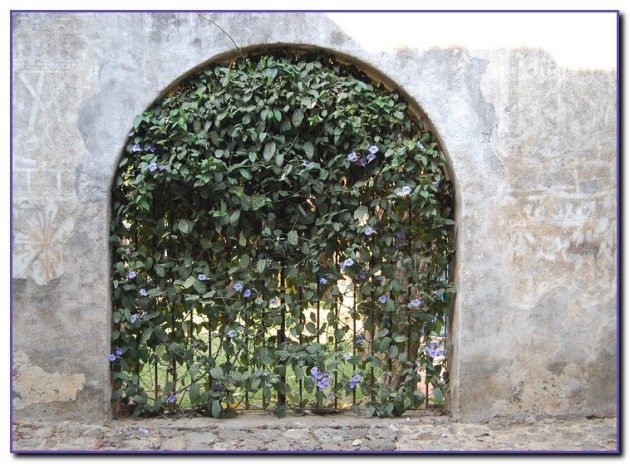
The image below was taken in Feb 2011 in Mexico, by a friend who attended a wedding there. Isn’t it beautiful?
Spring arrives on Mar 20, 2011
Image: Courtesy of J. Miglus – All rights reserved – Copyright 2011
____________________________________
And that’s the Friday Post #54 for Feb 25, 2011 folks. Enjoy your weekend!
Returning from a blogging-break, I found several links in my email account to a variety of newly-published library-related reports or scholarly articles. Two that I enjoyed reading are referenced below.
” We do not yet understand the scholarly significance of large swaths of the digital universe.”
I especially liked his caption “Libraries as Storehouses, Libraries as Tool Sheds”. As a mid-career librarian, the life work of my generation have been the planners, implementers and fixers for this migration of library collections from the Real (hold it in your hand, be in the library to read it) to the Virtual (it’s online 24×7 from anywhere you are). Another central issue for research libraries also focuses on historical archiving and reliable preservation of generations of printed, and digital, collections. The excerpt below from Dr. Hazen’s article summarizes such concerns much more eloquently than I can:
” The mass of information resources now available on the Web, many of them free, is fundamentally changing the library community’s thinking about collections…. Links to freely available digital content, meta-search capabilities that cut across products and platforms, and local aggregations of electronic resources, will all play a growing role in libraries’ collections and content strategies. This in turn will also reduce the physicality of library holdings and alter the functionalities of their spaces. But we need to go further. Three aspects of Web-based content require close attention. First, the search engines that today allow users to find materials on the Web are neither transparent nor fully revealing of useful content in predictable ways. Google Scholar, for example, relies upon opaque search algorithms and relevance rankings that appear not to fully exploit the wealth of standards-based metadata that libraries routinely provide. But most libraries do little better, investing their cataloged resources with robust metadata that our discovery tools rarely handle well. Second, sources on the Web—whether websites themselves or the data, images, objects, and documents embedded within them—are notoriously unstable. Content is added, changed, and removed; links shift around and disappear. Scholarship relies on enduring access to constant content, a goal which remains elusive in the digital domain. Capture, curation, and digital preservation are all implicated in this conundrum. Third, dispersed and disparate Web content requires tools that can work across amalgamated sets of sources in predictable and repeatable ways. Some of the uses are well-understood, while others reflect a new realm of inquiry that includes text mining, pattern recognition, visualization, and simulation. The needs are perhaps most pressing around massive accumulations of raw data. Libraries, working together and also with academics and information technologists, have an evolving role in creating and supporting the tools that will enable students and scholars to take full advantage of the digital world. It is not yet clear whether lead roles can or should be pre-ordained: arrangements that embody flexibility and contingency seem most likely to succeed. “
” Love for librarians remains. Like the library brand, it grew stronger. It seems that self-sufficient information consumers still appreciate expertise and a passion for learning—but they like it best on their time, with their tools. It’s cool to ask an expert—online. It was not cool to ask a librarian for help in 1950 (Public Library Inquiry, 1950); it’s still not cool. Many more perceptions and attitudes have remained the same for the information consumer in the last five years. She still wants to self-serve and self-navigate the info sphere. She discovered the benefits of surfing the Internet by 2003 and, by 2010, was using more powerful tools. She is creating her own apps. She still knows good information when she sees it. She takes her informationhabits, and perceptions, with her as she ages. While she may be a bit less impressed with online information resources as they have become commonplace, nothing has yet replaced the value and speed of a search engine. And, her personal device connects her to a network where she can share the knowledge gained. She shares her info sphere with older information consumers but does not welcome information gates or gatekeepers. Her advice for libraries: more hours, more content, more computers and of course—more books.
And any librarian in 2011 would not be surprised by this chart (also from the OCLC report):
*I prefer to believe that our users still have a need for reference librarians who are seasoned… a term much preferable to “old” (!). However canny, shrewd and wise will also win a smile from those behind that desk.
First: Best wishes for a Happy and Healthy New Year 2011 to everyone!
Since I have been writing this blog (which began in July 2007), I have yet to assemble a list of “favorite posts” from the backlist. The first week of a brand New Year seems like a good time to offer up this collection.
A continuing series called Show Me The Evidence. Part 1 is linked here. Part 2 – go here. And Part 3 (which has received the most hits over time) link is here.
UCHC Library is an institutional subscriber to the MD Consult database, which enables any registered library user to access the First Consult database via their mobile device. If you haven’t used FirstConsult before, it is a clinical point-of-care resource designed for busy clinicians who need fast answers in a “wherever, whenever” wireless environment. Below is a screenshot of First Consult apps page from iTunes:
Here are instructions on how to make it work on your iPhone/iPad:
1. If you have not previously set up an account with MD Consult, first you’ll need to create one (which is free and quick). Go to http://library.uchc.edu, then click on Databases, then scroll down to the MD Consult link.
The “Create Account” button is in the upper right-hand corner. (Without this step, your free FirstConsult app will only work for 60 days). See the screenshot below:
2. Next, using your mobile device, log into your MD Consult account. Then go to the iPhone App Store. Download the FirstConsult app into your device. Medical topics download occurs automatically; you should budget 30 minutes for the initial data downloading.







 Source: Both excerpts from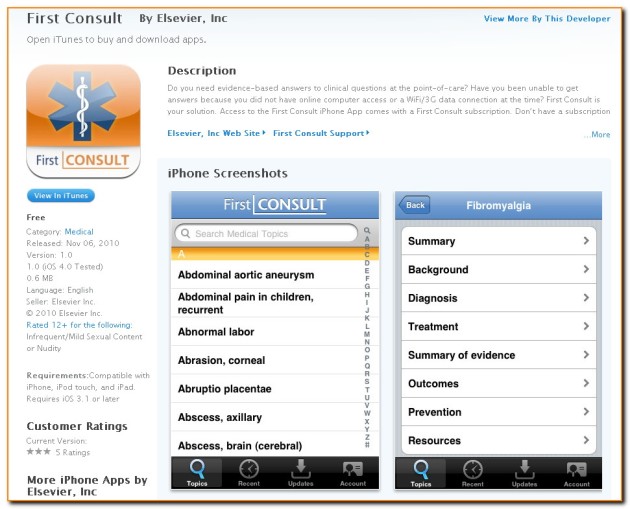


 MD-Consult


 EBM and Clinical Support Librarians@UCHC

Recent Comments